

A Rare Treasure of Vietnamese Folk Art
Among Vietnam's traditional folk painting traditions, Kim Hoàng paintings (Tranh Kim Hoàng) are perhaps the rarest.
Originating in Kim Hoàng Village, formerly part of Hoài Đức District, Hà Tây Province (now within Hanoi), this distinctive art form flourished during the eighteenth and nineteenth centuries. Although fewer works survive today than other Vietnamese folk paintings, Kim Hoàng remains an important chapter in the country's artistic heritage.
Its vibrant colors, expressive brushwork, and elegant compositions continue to inspire artists, historians, and collectors who value Vietnam's traditional craftsmanship.
A Tradition Shaped by Two Artistic Worlds
Kim Hoàng painting occupies a unique place in Vietnamese art because it combines characteristics found in two other major folk painting traditions.
Like Đông Hồ, artists used carved woodblocks to print the outlines of each composition.
Like Hàng Trống, artisans often completed the images by adding colors and expressive brushwork by hand after printing.
The result was a style that felt both structured and spontaneous, preserving the precision of woodblock printing while allowing each finished painting to retain the individuality of the artist's hand.
Rather than belonging entirely to one tradition or another, Kim Hoàng developed its own artistic identity.
Distinctive Colors and Handmade Paper
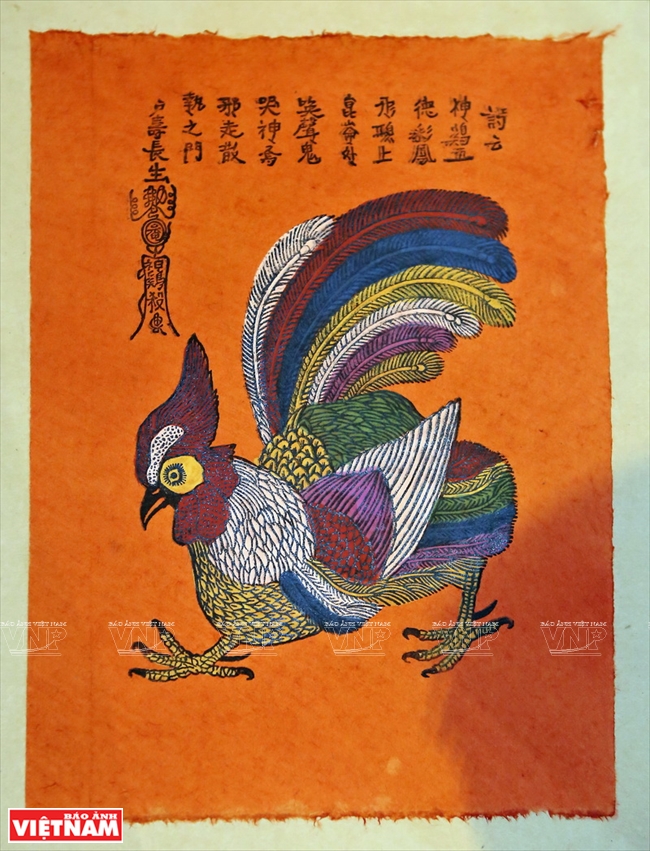
One of the most recognizable characteristics of Kim Hoàng paintings is the paper itself.
Unlike Đông Hồ paintings, which are traditionally printed on shimmering giấy điệp, many surviving Kim Hoàng works were printed on red or pink dyed paper, creating a dramatic background that immediately distinguished them from other Vietnamese folk paintings.
The printed outlines were then enhanced with hand-painted colors, allowing artisans greater artistic freedom than purely block-printed works.
The combination of bold paper, expressive brushwork, and decorative calligraphy gave Kim Hoàng paintings a distinctive elegance that remains recognizable today.
Paintings Filled with Symbolism
Although fewer examples survive today, Kim Hoàng paintings portray many of the same themes that appear throughout Vietnamese folk art.
Subjects include:
- Zodiac animals
- Prosperity
- Good fortune
- Rural life
- Traditional beliefs
- Wishes for happiness and abundance
Rather than serving only as decoration, these images reflected the hopes, values, and cultural identity of the families who displayed them, particularly during the Lunar New Year.
Their expressive style also reveals the growing influence of individual artistic interpretation within Vietnam's folk painting traditions.

A Tradition Nearly Lost
Unlike Đông Hồ, whose craft continued through multiple generations, Kim Hoàng painting experienced a dramatic decline.
Historical records indicate that severe flooding in the early twentieth century destroyed many original woodblocks and paintings, making it difficult for artisans to continue the tradition. As demand for handmade folk paintings also declined during the twentieth century, fewer practitioners remained to pass their knowledge to future generations.
Because so few original works survived, Kim Hoàng became one of Vietnam's rarest folk painting traditions.
Revival Through Research and Preservation
Although the original craft nearly disappeared, scholars, museums, and artisans have worked to preserve what remains.
Historical collections, surviving paintings, and archival research have allowed researchers to better understand Kim Hoàng's techniques and artistic style. Contemporary artisans have also begun recreating selected works using traditional methods, helping introduce this remarkable tradition to new audiences.
These efforts demonstrate that cultural heritage can continue to evolve even after periods of decline.
Inspiration Behind the Ao Dai Art Zodiac Collection
Our Vietnamese Zodiac Collection draws inspiration from several of Vietnam's historic folk painting traditions, including Kim Hoàng.
Rather than reproducing historical paintings, we reinterpret their artistic spirit through miniature áo dài designs that celebrate Vietnam's enduring creativity and cultural heritage.
By sharing these stories alongside our collections, we hope to encourage greater appreciation for artistic traditions that deserve to be remembered and preserved.
Why Kim Hoàng Still Matters
Kim Hoàng paintings remind us that cultural heritage is not measured only by how many artworks survive.
Sometimes the traditions that come closest to disappearing become the ones that teach us the most about preservation, resilience, and the importance of passing knowledge from one generation to the next.
Today, every exhibition, research project, and artistic revival helps ensure that Kim Hoàng remains part of Vietnam's cultural story rather than simply a forgotten chapter in history.
0 comments